Q. The following factors are likely to reduce the benefit of thrombolysis?
More severe stroke – False – although although the risk of bleeding is higher with severe stroke, this increased risk is offset by the greater benefits in severe stroke.
Shorter interval since last well – False – if the interval is shorter the benefits are greater.
Taking an oral anticoagulant – True – this will be associated with a greater risk of bleeding, and reduced benefit.
Greater age – False – the elderly gain at least as much benefit from thrombolysis as younger people.
Recent history of stroke – True – a recent history of stroke has been associated with a greater risk of intracerebral bleeding after thrombolysis, and therefore reduced benefit.
Systolic blood pressure above 180mmHg – True – very high BP is perceived as being riskier, and thus potentially reducing the benefits of thrombolysis.
Epileptic seizure since onset – True – an epileptic seizure may mimic a stroke, or make it appear more severe than it actually is – therefore the benefit of thrombolysis may be less.
Recent trauma, operation or bleeding – True – this may increase the risk of bleeding, and reduce the benefits.
Taking an oral contraceptive – False – there is no evidence this reduces the benefit.
BM stick is very High (>22mmol/l) – True – a very high or low BM can be associated with focal neurological symptoms which may mimic a stroke, so that thrombolysis may not be of any benefit. Also, some concern that very high BM may increase risk of bleeding.
Q. Should Jimmy have thrombolysis and/or thrombectomy?
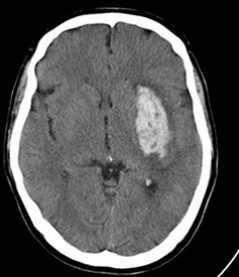
The CT scan shows no abnormality- False – it shows a large are of high density (white) on the left side of his brain.
This is the appearance of an acute intracerebral bleed – True – an ischaemic stroke might not be visible in the first few hours, and if it is, it appears darker (darker grey) than the surrounding brain.
Jimmy should be treated with thrombolysis – False – this would be very dangerous and would be likely to kill Jimmy.