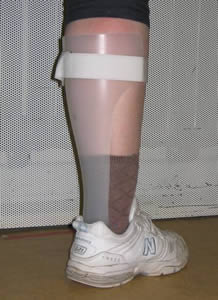
Q. What is an AFO and what does it do?
Ankle Foot Orthosis (AFO): An AFO is a device worn on the lower part of the leg to provide direct control of motion and alignment of the ankle and foot.
Ankle Foot Orthosis (AFO): An AFO is a device worn on the lower part of the leg to provide direct control of motion and alignment of the ankle and foot.
He starts walking with supervision of a nurse to and from meals and requires a stick and an AFO. Alan is aware of the technique to use and the safety issues.
Alan is keen to walk on the ward. The key worker takes Alan’s request to the MDT meeting.
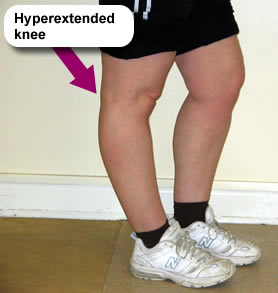
Alan can stand unaided but tends to lose his balance when reaching for objects and has active movement in his hip and knee but his leg is generally weak. He has flickers of movement at his ankle but is unable to pull his foot up. When walking Alan presents with a dropped foot. This means that he can’t lift his foot clear of the ground when swinging his leg through and is at risk of falling. Additionally when standing on his leg his knee tends to flick back into hyperextension (sudden uncontrollable straightening of the knee beyond normal – see photograph below) which could cause long term damage to his knee joint. Alan has been provided with a custom made ankle foot orthosis (AFO) to help with these issues and is currently walking in therapy with the help of a therapist.
Photograph showing a hyperextended knee
Alan approaches you and says that he wishes to walk on the ward. How should you manage this?
Alan has had Botulinum Toxin to his finger and wrist flexors and stretches and exercises to improve the motor control. This has helped his hand and has improved the functional use of his arm. He can now clean his hand and has flickers of active movement at his wrist and fingers. Following education in stretches and application of the splint, Alan feels that he is competent to apply it. He is happy with the management of his hand and is less distressed about the appearance of his hand.
Why would splinting be used?
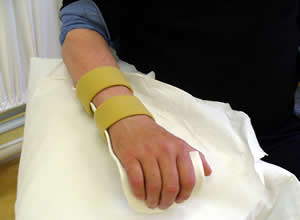
Caution: Hand splinting alone will not improve upper limb function or reduce tone. It is a valuable adjunct to other management interventions such as physiotherapy, spasticity management etc. It is therefore important that there is careful consideration for the rationale for selecting this intervention.
Alan has been provided with a custom made hand splint by the therapist. Splint application can be effective if there is good team working. Drag the possible solutions to match the potential issues that may occur.
Alan’s spasticity management goals are to:
The main aim is to optimise the outcome of his upper limb rehabilitation

As part of his spasticity management Alan attends a spasticity management clinic for assessment and treatment options. As as result of this assessment he has had Botulinum Toxin injections into his wrist and finger flexors. In order to maximise the benefit of this he now needs to follow an appropriate management plan including:
For a description of what a spasticity clinic is see additional information.
Link: Spasticity in adults: management using botulinum toxin National guidelines (2nd edition).RCP March 2018 (PDF).
There are a number of options which you could now consider for managing Alan’s tone.